
Chasing afterglow with legends.
One of my last aviation photoshoot was absolutely electric! There is nothing quite like the sight of warbirds basking in the night.
Getting up close to these icons of aviation history after dark was a total dream come true for the lens!
The objective of the session was to photograph three aircraft from the museum's collection with their engines running:
Curtiss P-40E-1 Warhawk
Bell P-63A-7 King Cobra
Noorduyn Norseman
A massive THANK YOU to the Yanks Air Museum and it's team, with a special mention for Mr. Casey, for this great experience. Your hospitality and the opportunity to capture these magnificent machines in such a unique setting made for an unforgettable session. It’s an honor to help tell their story through my craft.

Yanks Air Museum’s Curtiss P-40E-1 Warhawk, Chino (CA). © Gérald WILLIG
Aviation night photo shoots are exciting but present unique technical and safety hurdles.
Technical Challenges
Night photography is all about finding and controlling light in the dark. Whether you're capturing city streets, portraits, or the stars, the goal is to balance stability with your camera's sensitivity to keep images sharp and clear.
The primary challenge is the lack of light, which forces you to use longer exposure times—sometimes ranging from 2 to 20 seconds—making camera stabilization your top priority.
Camera Shake & Stabilization: Handholding a camera is nearly impossible at night, as even tiny vibrations will blur the image. A sturdy, heavy tripod is essential, especially in windy conditions.
Focusing Difficulties: Low light often causes autofocus to fail. Pro photographers often use Live View with manual magnification or shine a high-powered torch on the aircraft to give the sensor enough contrast to lock focus.
Inconsistent Lighting: Airfields often use multiple light sources (poles, trucks, hangar lights) with different intensities and color temperatures. This can lead to harsh overexposure on white aircraft liveries or strange color casts that require intensive post-processing.
Accessories: Bring a flashlight to help see your settings and focus, extra batteries (long exposures and cold weather drain them fast), and a lens hood to block flares from lights around you.
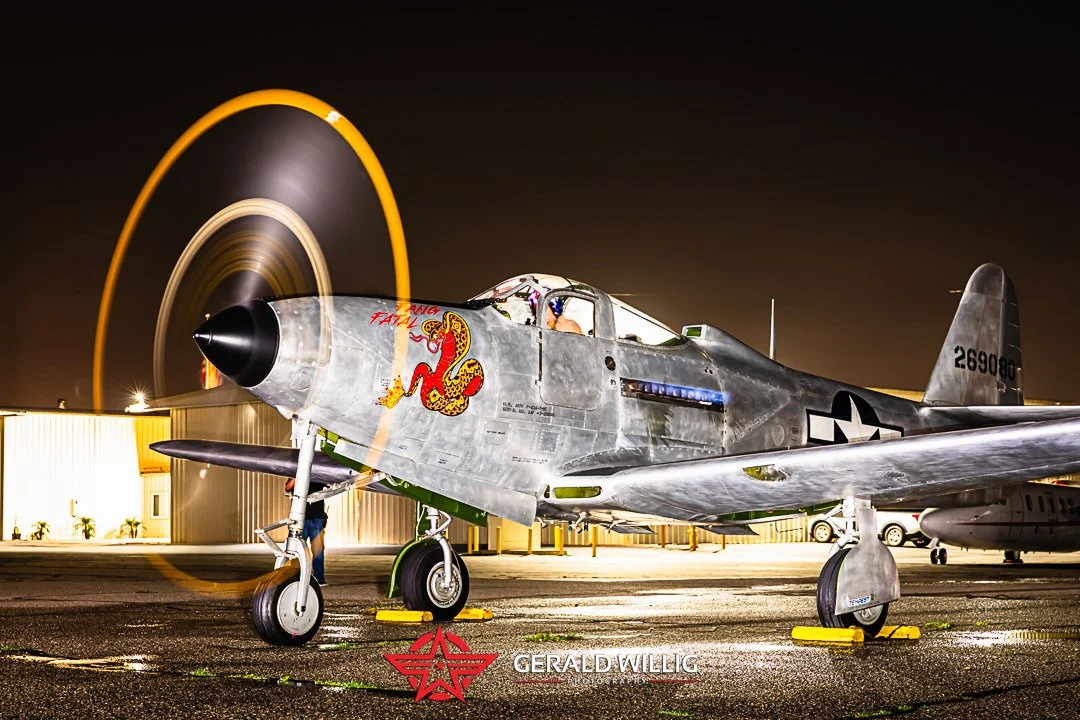
Yanks Air Museum’s Bell P-63A-7 King Cobra, Chino (CA). © Gérald WILLIG
Mastering Your Settings
Manual Mode: Auto mode often fails at night by over-flashing or blurring. Use Manual (M) to control every setting yourself.
ISO vs. Noise: While modern cameras can push to ISO 12,800, high ISO often introduces significant noise, especially in dark shadow areas like under wings. Using base ISO (100–200) with a tripod is generally preferred for the cleanest results.
Aperture: Open as wide as possible (lowest f-stop) to gather light. Use smaller apertures (f/11+) for best sharpness only if you're on a tripod .
Shutter Speed: Use slow speeds (5–30 seconds) on a tripod to allow enough light in .
Focusing: Cameras struggle to autofocus in the dark. Use Live View, zoom in on a light source digitally, and focus manually until it's tack-sharp.
White Balance: Set manually (e.g., 5600K) to avoid color shifting, or choose a cooler tone for a "night" feel.
File Format: Shoot in RAW to maximize editing flexibility. This format preserves the most detail, giving you much more flexibility to fix exposure and reduce noise in post-processing.

Yanks Air Museum’s Noorduyn Norseman, Chino (CA). © Gérald WILLIG
Compositional Challenges
Motion Blur: Capturing movement, such as "prop circles" from spinning propellers, requires a delicate balance of slow shutter speeds (around 1/125th or slower) without blurring the rest of the aircraft. For a night session, with a good tripod, it's not an issue. However depending on the engine RPMs and propeller speeds, the aircraft may also pitch upward, resulting in motion blur that will be visible in the photographs.
Background Clutter: It is essential to pay close attention to framing and to take into account—as much as possible within the allotted time—every detail. External lights often illuminate messy backgrounds like hangar equipment or fences, which may need to be "darkened" or edited out later to keep the focus on the aircraft.
Safety & Operational Challenges
Safety Gear: High-visibility vests are often mandatory on airfields.
Airfield Hazards: Tripods become significant trip hazards in dark conditions where crews are actively moving. Photographers must also remain vigilant for moving vehicles or aircraft being towed.
Crowdline: Be mindful of other photographers; try not to let your shadow enter others' frames.
Be Patient: Long exposures take time; review your shots, adjust, and re-shoot
Strict Time Constraints: Organized night shoots often provide several hours, but military exercises or active runway shoots may only grant a few minutes to capture the perfect shot. Here the time constraints were imposed by rising engine temperatures (the engines must not overheat, leaving a window of just a few minutes at most per aircraft).
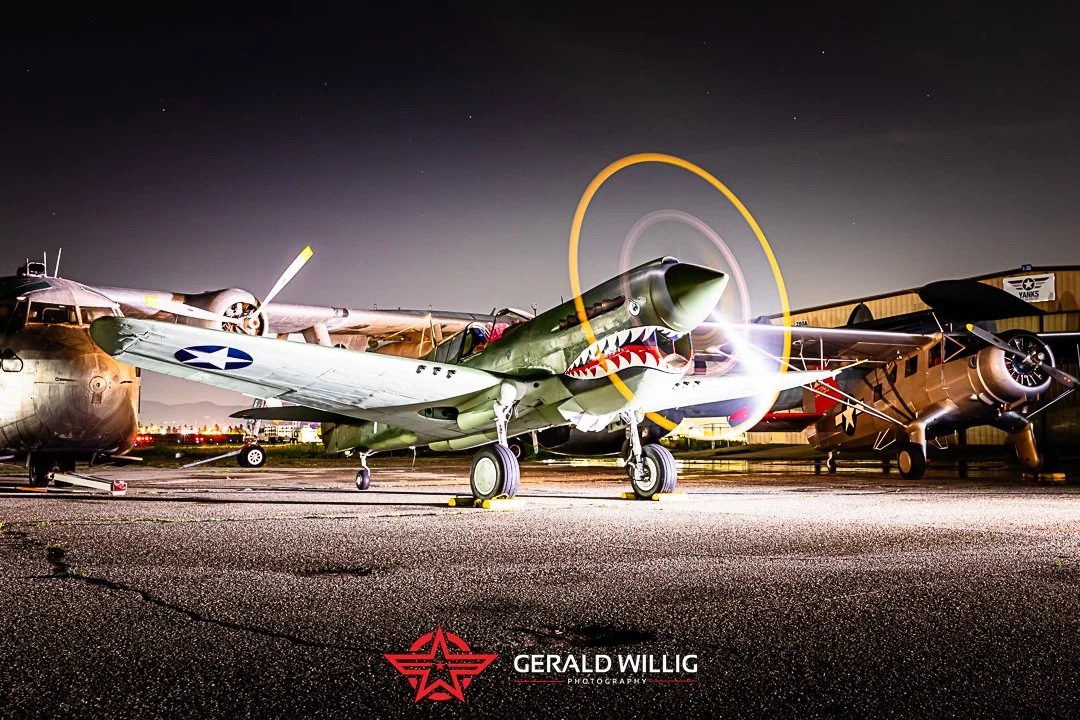
Yanks Air Museum, Chino (CA). © Gérald WILLIG
About the aircrafts photographed in this session
✈ Curtiss P-40E-1 Warhawk
The popular shark mouth, well suited to the contours of the P-40, was made famous by the 1941 American Volunteer Group (AVG), also known as the “Flying Tigers.” Flying out of China, Claire Chennault’s 215 pilots earned a record of 286 kills to four losses. After the United States entered the war, the AVG became part of the USAAFs 23rd Fighter Group.
By 1941 almost 14,000 P-40s were delivered, making it the first mass produced US fighter, at a unit cost of $57,000.00. The P-40 was America’s fighter at the time of the attack on Pearl Harbor, December 7th, 1941. The P-40 was well liked by its pilots and ground crew, despite its altitude restrictions.
On April 18, 1943, 46 P-40s with 11 Spitfires caught 60 JU-52s and an escort of 21 fighters. The “Palm Sunday Massacre” that followed led to the downing of 59 of the transports and 16 escorts for the loss of only six P-40s.
After WWII, this surplus P-40 was used as a commercial cloud seeder until procured by Yanks in 1975 as the second aircraft in our collection.
Service History
Delivered: 10/22/41
12/3/41 RCAF on direct British Order Sqd. #118
Stricken: 8/23/46
✈ Bell P-63A-7 King Cobra
It soon became clear a larger and more powerful aircraft was needed for a close support fighter bomber. Experimental XP-63’s used the P-39 fuselage and added aerodynamic improvements.
The P-63 King Cobra was produced and supplied in great numbers to the USSR and France. Outperformed at high altitude by the P-51 Mustang and P-47 Thunderbolt, the P-63 King Cobra was relegated to training duty by the AAF.
Over 300 P-63s were used by the AAF as manned targets. All armament was removed and duralumin alloy was added to the fuselage and tail for protection. Bulletproof glass, steel plate and a special hollow blade prop allowed the plane to withstand impact from the training programs infrangible bullets.
The P-63 seen here “Fatal Fang” was acquired from the Bob Bean Collection in 1978 and restored.
Service History
Delivered: May 8, 1944
May 1944 – Base Unit 4th AAF Portland, OR
June 1944 – 433 Base Unit 4th AAF Chico, CA
August 1944 – 31st Fighter Sqd 4th AAF Palmdale, CA
November 1944 – 421st Base Unit 4th AAF Muroc, CA
July 1945 – 405th Base Unit 4th AAF Paine, WA
Oct 1945 – Ontario, CA disposed as surplus
✈ Noorduyn Norseman
The Noorduyn Norseman is a legendary Canadian single-engine bush plane designed by Robert B.C. Noorduyn in 1935, specifically for rugged, remote, and arctic operations. Known as a "one-ton flying truck", it was widely used on wheels, floats, or skis, with over 900 produced for civilian and military roles—primarily as the UC-64A for the USAAF—until 1959.
Performance & Specs: Typically powered by a 600 hp Pratt & Whitney R-1340 Wasp radial engine. It has a max speed of 162 mph, a cruising speed of 148 mph, and a range of 1,150 miles.
Design & Utility: Renowned for its versatility in hauling heavy loads into unimproved landing areas.
It features a high-wing configuration, durable steel-tube framework, and a large cargo capacity.
Production & Legacy: About 903 to 904 units were built (Mk. I through Mk. V/VI). They were utilized in 68 countries and operated in both the Arctic and Antarctic regions.
Military Service: Over 700 units were produced as the UC-64A for the United States Army Air Forces during WWII, along with service in the Royal Canadian Air Force.
Historical Significance: One of the most successful Canadian-designed aircraft, often referred to as "the Harley Davidson of the sky". The aircraft gained notoriety when a UC-64A carrying Glenn Miller disappeared in 1944.
Current Status: A small number of these aircraft remain active today on the Canadian (approx. 42) and US registries, maintained as vintage aircraft.
Commonly seen in Canadian aviation museums and collections, the Norseman was vital in opening up northern Canada and remains a symbol of bush flying.
The Yanks Air Museum’s Noorduyn Norseman was recently fully restored by it’s team to our great delight.

Yanks Air Museum’s Curtiss P-40E-1 Warhawk, Chino (CA). © Gérald WILLIG
Once again, a big thank you to the Yanks Air Museum and it’s whole team for this opportunity and for their welcome!
Yanks Air Museum is a rare gem nestled in the humble town of Chino, CA. Yanks Air Museum museum is dedicated to exhibiting, preserving and restoring American aircraft and artifacts. The museum has over 200 aircraft on display and houses one of the largest and most historically significant collections of American aircraft including World War II warbirds and more modern jet aircraft.
If you don’t know this museum, or, if you haven't been there in a long time, I recommend visiting it. You won't regret it.
Ultimately, I believe the results of this night photoshoot are well worth the effort. What do you think?
📸✈👉 Follow me @GeraldWillig on Instagram to enjoy more posts and at Gerald Willig Photography on Facebook.